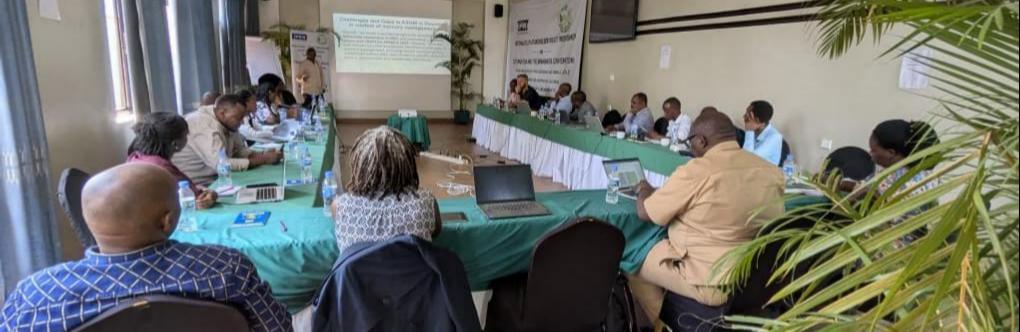
The Association Rwandaise des Ecologistes (ARECO-RWANDA NZIZA), with support from the International Pollutants Elimination Network (IPEN), convened a National Multi-Stakeholder Policy Workshop on Strengthening the Minamata Convention in Kigali on 8 September 2026. The workshop brought together 25 representatives from government institutions, civil society organizations, the private sector, media houses, and the World Health Organization (WHO) to discuss practical measures for strengthening mercury control and advancing mercury-free artisanal and small-scale gold mining (ASGM) in Rwanda.
The workshop opened with remarks from Octavien Ngirabakunzi, Environment and Climate Change Outreach Officer at the Rwanda Environment Management Authority (REMA), and Balthazar Twagilimana, Vice Chairperson of ARECO-RWANDA NZIZA. Participants reviewed a policy brief, findings from the national assessment, and priority policy actions needed to strengthen mercury management in Rwanda.
Discussions focused particularly on two proposed amendments to the Minamata Convention: ending the legal global trade in mercury and establishing 2032 as the phase-out date for mercury use in artisanal and small-scale gold mining.
Participants recognized the progress Rwanda has made in promoting mercury-free ASGM, particularly since the country joined the Minamata Convention in 2017. However, they also emphasized that mercury remains a serious threat to human health and the environment and that continued efforts are needed to consolidate and sustain mercury-free mining practices.
The workshop called for stronger harmonization of mercury-related laws and regulations across the East African region to address regulatory gaps and prevent cross-border movement of mercury. Participants also highlighted the importance of strengthening cooperation, monitoring, coordination, and data sharing among environmental, health, mining, and other relevant institutions.
Greater awareness and advocacy were identified as essential to ensuring that miners, mining communities, local authorities, and other stakeholders understand the health and environmental risks associated with mercury. Participants also emphasized the need to document and share Rwanda’s progress and good practices in promoting mercury-free ASGM.
The discussions further highlighted the importance of strengthening research and environmental monitoring, including the assessment of mercury levels in water, soil, air, and human blood. Regular training on the Minamata Convention, mercury risks, mercury-free mining practices, and relevant national policies and regulations was also identified as an important measure for building capacity among government officials, miners, civil society organizations, and other stakeholders.
Participants also called for greater access to safer, mercury-free gold processing technologies through technical support, demonstrations, awareness-raising, and capacity building, alongside stronger enforcement and compliance mechanisms to support restrictions on mercury use and trade in the ASGM sector.
The workshop provided an important platform for stakeholders to exchange knowledge, assess progress, and agree on practical actions to strengthen mercury control in Rwanda. Through continued collaboration and concerted action, stakeholders reaffirmed the importance of advancing a safer, healthier, and mercury-free future for Rwanda’s artisanal and small-scale gold mining sector.